For commercial interior contractors and building material importers, the Ceiling Tee Bar (T-Grid) is the backbone of any suspended ceiling system. While different brands may look identical at a glance, subtle variations in metallurgy, engineering, and manufacturing can drastically affect the structural integrity of a building's ceiling.
In this technical guide, we break down the core engineering metrics that define a high-quality ceiling tee bar system.

1. Base Metal Thickness (BMT) vs. Total Coated Thickness (TCT)
When sourcing a ceiling tee bar, clarity on steel thickness is paramount.
BMT (Base Metal Thickness): The actual thickness of the structural steel core before any coatings are applied.
TCT (Total Coated Thickness): The final thickness including the galvanized zinc layer and the baked enamel paint.
Buying Tip: Unreliable suppliers often quote TCT while passing it off as BMT to cut costs. For heavy-duty commercial plasterboard or mineral fiber ceilings, a reliable main runner should have a steel core thickness of at least 0.26mm to 0.35mm to prevent structural deflection (sagging).
2. Zinc Coating Weight (Galvanization Mass)
The longevity of a ceiling tee bar depends entirely on its rust-resistance, which is determined by the zinc coating on the hot-dipped galvanized steel coil.
Z40 to Z60 (40–60 g/m²): Suitable for standard dry commercial interiors with regulated HVAC systems.
Z80 to Z120 (80–120 g/m²): Recommended for high-humidity environments, coastal construction projects, or tropical regions (e.g., Southeast Asia, Middle East).
Insufficient galvanization leads to premature rusting, which stains acoustic tiles and compromises the safety of the entire suspended ceiling grid.
3. The Engineering of the Lock/Clip System
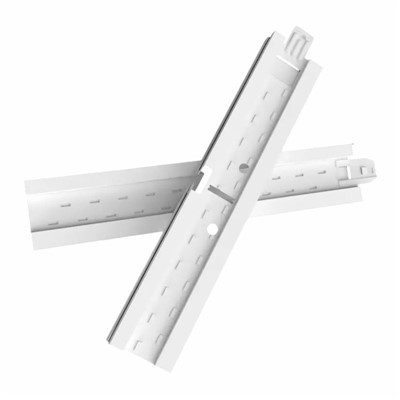
The interlocking clip mechanism at the end of the Cross Tee determines both installation speed and seismic safety. There are two primary configurations in global markets:
Alloy Hook / Staked-on Clip: Features a separate, high-tensile alloy clip attached to the end of the T-bar. It provides an audible "click" sound when locked into the Main Runner, ensuring a rigid connection with exceptional pull-out resistance.
Integral / Integral Fire-Front Lock: The lock is stamped directly out of the runner's body steel. While more economical, it requires precise alignment and is usually preferred for lighter-weight ceiling tile layouts.
4. Double-Stitch vs. Single-Stitch Webbing
If you look closely at the vertical section (the web) of a premium ceiling tee bar, you will notice a row of stitched indentations. This is called rotary stitching.
Double-Stitching: Mechanically locks the two layers of steel together before the final roll-forming profile is shaped. This process significantly increases the torsional rigidity (resistance to twisting) of the profile during transit and handling on-site.
Technical Summary Checklist for Sourcing
| Evaluation Feature | Premium Quality Benchmark | Common Low-Cost Compromise |
|---|---|---|
|
Material Base |
Hot-dipped galvanized steel coil | Cold-rolled steel with thin electro-galvanizing |
|
Deflection Limit |
Meets structural classification | Warps under heavy mineral wool tile load |
|
Paint Finish |
Baked enamel paint (anti-chipping & color-matched) | Standard spray paint (prone to scratching) |
|
End Clip |
High-tensile alloy clip with fire-expansion slots | Thin integrated cut-out tabs |
By understanding these technical nuances, wholesale buyers can avoid costly project failures and negotiate better terms with factories. Always request independent testing reports (such as SGS or CE certifications) for load capacity and fire safety before finalizing a bulk container order.