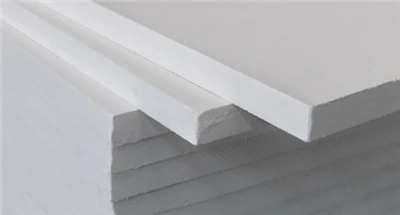
In modern commercial, industrial, and passive fire-protection engineering, selecting the right structural and lining panel is critical to building safety and lifecycle durability. Among inorganic building materials, a high quality calcium silicate board stands out for its unique combination of Class A1 non-combustibility, dimensional stability in high humidity, and long-term mechanical strength.
To help architects, engineers, and international buyers understand why this material outperforms conventional gypsum or organic wood-based panels, this technical guide breaks down its core composition, manufacturing process, and material science.
1. Core Chemical Composition: What Makes It Inorganic and Stable?
Unlike gypsum board (which relies on hydrated calcium sulfate and paper facings) or plywood (which consists of organic wood veneers and adhesives), a high quality calcium silicate board is engineered from purely inorganic mineral matrices reinforced with selected fibers:
Siliceous Materials (SiO₂): High-purity quartz sand or micro-silica provides structural hardness, thermal stability, and chemical resistance.
Calcareous Materials (CaO): Refined quicklime or hydrated lime reacts with silica during curing to form stable calcium silicate hydrates.
Reinforcing Fibers: Alkali-resistant cellulose fibers, mineral wool, or synthetic fibers (100% asbestos-free) are evenly dispersed throughout the slurry to deliver high flexural and impact strength.
Functional Additives: Controlled mineral fillers optimize board density, thermal insulation, and surface machinability.
2. The Autoclave Curing Process: The Secret Behind Superior Durability
The defining stage in producing a high quality calcium silicate board is high-temperature, high-pressure hydrothermal curing inside industrial autoclaves-a process fundamentally different from natural air-drying.
Pulping & Precision Slurry Mixing: Raw materials and fibers are blended with water in computer-controlled mixers to ensure homogeneous fiber distribution without clumping.
Hatschek / Flow-On Sheet Forming: The slurry is formed into thin, multi-layered laminations and compressed under high tonnage to eliminate internal air voids and achieve uniform thickness.
High-Pressure Autoclave Curing: Green boards are placed in sealed autoclaves at temperatures around 180°C–200°C and saturated steam pressures of 1.0–1.5 MPa for 12 to 24 hours. Under these conditions, silica and lime chemically synthesize into tobermorite crystals-a stable, interlocking crystalline structure responsible for the board's ultra-low shrinkage and high strength.
Drying, Sanding & Edge Calibration: Cured boards are dried to equilibrium moisture content and precision-sanded on automated calibration lines to achieve smooth surfaces and tight dimensional tolerances.
3. Key Physical & Mechanical Properties Explained
Thanks to its tobermorite crystal network, a high quality calcium silicate board exhibits distinct advantages over standard wallboards:
Zero Combustibility & Fire Integrity (Class A1): Because its mineral matrix contains no organic binders, the board does not ignite, propagate flame, or emit toxic smoke under extreme heat, making it ideal for fire-rated partitions, steel beam encasements, and smoke-extraction ducts.
Moisture & Freeze-Thaw Resistance: Unlike gypsum, which softens and loses strength when wet, calcium silicate retains over 75% of its dry flexural strength even when saturated, with a wet-to-dry movement rate typically below 0.25%.
Alkaline Resistance & Anti-Corrosion: Its stable mineral chemistry resists mold, fungi, termites, and mild chemical fumes, extending service life beyond 30 years in coastal, tropical, or industrial environments.
4. Density Classification & Engineering Selection Guide
In industry standards, calcium silicate boards are generally categorized by density to match specific load and thermal requirements:
| Density Category | Typical Density | Primary Engineering Applications |
|---|---|---|
|
Low / Medium Density |
500 – 1,000 kg/m³ | Industrial thermal insulation, furnace linings, high-temp pipe & boiler backing (up to 650°C–1,000°C). |
|
Standard Construction Density |
1,150 – 1,350 kg/m³ | Suspended ceilings, interior partition walls, wet-area tile backing, acoustic wall linings. |
|
High Density |
1,400 – 1,650 kg/m³ | Exterior facade cladding, steel structure mezzanine flooring, heavy-duty fire ducts, soffits. |