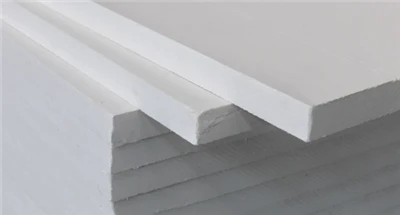
For ceiling tile manufacturers running PVC gypsum board production lines, embossed PVC film is the input that determines finished product quality more than any other raw material. Getting the specification wrong does not show up at lamination. It shows up when the contractor calls.

Why Film Specification Failures Are Expensive
The tile manufacturer absorbs the cost of a film-related complaint - not the film supplier.
Yellowing tiles in a completed commercial installation cannot be selectively replaced without visible evidence of the repair. The entire affected area is replaced at the tile manufacturer's cost. The film that caused the problem cost less per roll than the specification that would have prevented it.
Peeling film at tile edges generates contractor callbacks that trace back through the distributor to the manufacturer. By the time the source is identified as film adhesion incompatibility rather than lamination error, multiple parties have spent time and money on a problem that a compatibility check before ordering would have eliminated.
Pattern inconsistency across a roll produces batches of tiles with visibly different emboss depth. In an installed ceiling viewed under raking light, the variation is immediately apparent. The installed quantity determines the replacement cost. The roll specification determined the outcome.
The Specifications That Determine Performance
Film weight. The weight range from 70g to 110g per meter covers three distinct performance tiers. Below 85g, UV stability and emboss depth retention are adequate for short-cycle residential applications. At 85–100g, the film meets the durability requirements of commercial export markets. At 110g, the surface quality is sufficient for premium hospitality and high-specification institutional applications. Specifying below the required weight to reduce input cost is the most reliable way to generate quality complaints twelve months after delivery.
Emboss consistency. Pattern depth must be consistent across the full 1,230mm roll width and maintained across roll length. Variation across width produces visible differences between tiles cut from the same roll. Variation across length produces batch-to-batch differences that appear when tiles from different production runs are installed in the same ceiling.
Adhesion compatibility. PVC film for gypsum board lamination must be chemically compatible with the EVA hot-melt adhesive system used on the production line. Incompatible film produces bonds that appear correct at the lamination stage and degrade under the humidity cycling that occurs in all occupied buildings.

SEYI Product Range
Width: 1,230mm or customization. Length: 450m–1,000m per roll. Weight: 70g–110g per meter. Compatible with gypsum board, cement board, mineral fiber board and composite board.
✅ 100+ color and pattern options
✅ White series / color series / 3D emboss series
✅ 100% waterproof surface
✅ Fire-resistant formulation
✅ Custom pattern development available
✅ MOQ flexible - trial rolls accepted
Summary
The embossed PVC film specification decision is made once per order and affects every tile that leaves the production line until the next order is placed. For manufacturers supplying export markets in Africa, Latin America and the Middle East - where quality complaints travel back through distribution chains slowly and replacement costs accumulate before the source is identified - getting the specification right at the point of ordering is significantly cheaper than correcting it after delivery.
SEYI supplies embossed color design PVC film for gypsum board lamination - 70–110g, 1,230mm width, 100+ patterns - factory-direct with flexible MOQ and full export documentation across Africa, the Middle East, Latin America and Central Asia.