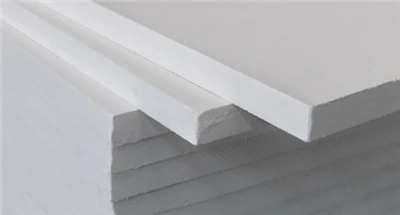
Low Density Calcium Silicate Board is a high-performance inorganic building material that plays a critical role in modern architectural passive fire protection and industrial insulation.
1. Technical Definition
Low density calcium silicate board is manufactured from siliceous materials (such as quartz powder, diatomaceous earth) and calcareous materials (such as lime, cement), reinforced with plant fibers. The mixture undergoes slurry or paper-making molding followed by a high-temperature, high-pressure autoclaving process. This triggers a hydrothermal reaction to form stable tobermorite crystals.
Density Range: The industry defines boards with a density between 0.5 to 0.8 g/cm³ (or even lower) as low density. In contrast, standard or high-density boards usually exceed 1.2 g/cm³.
Microstructure: The low density means the board's interior is packed with microscopic air pores. This honeycomb-like structure gives the material its signature lightweight and thermal insulation properties.
2. Core Technical Advantages
🔥 Ultimate Fire Resistance (A1 Non-combustible)
It is certified as a Class A1 non-combustible material. In a fire, it does not burn, melt, or emit toxic smoke. Combined with steel structures or light-gauge steel framing, it easily achieves a system fire rating of 1 to 4 hours.
📐 Superb Thermal Insulation
Due to its porous core, it has an exceptionally low thermal conductivity (typically around 0.09–0.15 W/(m·k)). This effectively blocks heat transfer, making it ideal for passive fire protection and energy saving.
💨 Lightweight with Structural Integrity
Its low density significantly reduces the dead load of buildings. It lowers transportation costs and simplifies handling and installation on high-rise construction sites.
💧 Exceptional Dimensional Stability
Unlike gypsum boards, it does not sag, soften, or mold when exposed to moisture. The autoclaved tobermorite crystal structure ensures minimal moisture expansion and dry shrinkage rates.
3. Density Comparison: Low vs. High Density
Understanding the distinction between densities is vital for correct project specification:
Low Density Boards (0.5 – 0.8 g/cm³)
Primary Focus: Exceptional fire ratings, thermal insulation, weight reduction, and acoustic absorption.
Thermal Performance: Extremely low thermal conductivity (superior heat insulation).
Mechanical Strength: Moderate flexural strength, optimized for non-load-bearing fire barriers and structural cladding.
Medium & High Density Boards (0.9 – 1.4+ g/cm³)
Primary Focus: Mechanical strength, high impact resistance, heavy moisture resistance, and exterior durability.
Thermal Performance: High thermal conductivity (poor heat insulation).
Mechanical Strength: Extremely high flexural and impact strength, capable of withstanding heavy physical wear.
4. Key Application Scenarios
Low density calcium silicate boards are utilized as critical components in high-standard architectural systems:
Fire-Rated Ductwork Enclosures (HVAC Flue Wrapping):
One of its most rapidly growing applications. It is widely used to wrap smoke extraction and ventilation ducts, ensuring ventilation systems remain operational during fire emergencies.
High-Rise Fire Partition Walls & Ceilings:
Installed in commercial complexes, star-rated hotels, and public buildings for corridor ceilings and firewall partitions. It delivers high fire-resistance ratings without overloading the floor slabs.
Structural Steel Fireproofing:
Used to box-clad structural steel beams and columns. Since steel loses its load-bearing capacity around 500°C, the board delays temperature rise, buying valuable time for evacuation.
Marine & Industrial Insulation:
Applied in shipbuilding (bulkheads and ceilings) and industrial furnaces where lightweight, thermal barriers, and moisture resistance are strictly required.
5. Future Industry Trends
100% Asbestos-Free & Eco-Labeling: The global market demands green building materials. Modern production completely eliminates asbestos, utilizing bio-fibers and recycled industrial by-products to achieve carbon reduction.
Pre-fabricated & Composite Systems: Integrating low-density boards with finish materials or acoustic insulation in factories allows for fast, modular on-site assembly, aligning with modern off-site construction methods.
The "Lower Density, Higher Strength" Frontier: Ongoing R&D focuses on modifying the crystalline microstructure to lower densities down to 0.4 g/cm³ while maintaining excellent screw-holding capacity and structural integrity.