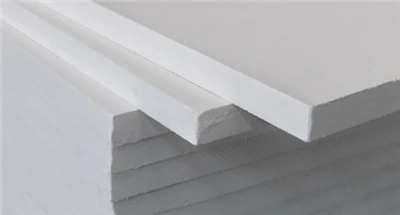
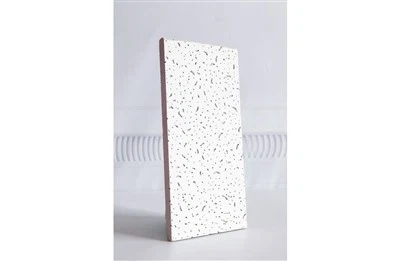
Classification & Technical Types
Mineral wool ceiling tiles are categorized primarily by edge profiles (installation method) and relative humidity (RH) tolerance:
By Edge Profile
Square Edge (Lay-in): Standard flat-edge tile designed to sit flush within an exposed T-bar grid system. Cost-effective and straightforward to install.
Tegular Edge (Reveal/Drop-down): Features a precision-cut step along the perimeter, causing the panel face to drop slightly below the grid plane, creating a refined 3D dimensional shadow line.
Concealed / Vector Edge: Specially kerfed edges hide the supporting suspension grid entirely, yielding a seamless, monolithic ceiling plane.
By Moisture Resistance
Standard Moisture-Resistant: Ideal for controlled indoor environments with Relative Humidity (RH) levels up to 70%–80%.
High Humidity / Anti-Sag (RH90–RH99): Enhanced with hydrophobic agents and high-density binders to prevent board warping or sagging in non-air-conditioned spaces or high-humidity regions.
Quality Inspection & Selection Guide
When evaluating or specifying mineral wool ceiling tiles, consider these four critical criteria:
Density & Core Integrity: High-quality panels offer a firm, solid core without crumbling along cut edges, balancing structural rigidity with light weight.
Coating Uniformity & Light Reflectance: Premium options feature uniform, high-reflectance white factory coatings (LR $\ge$ 0.85) that diffuse light evenly and reduce artificial lighting requirements.
Perforation Quality: Clean, uniform pinholes and fissures ensure consistent sound absorption without compromising structural integrity.
Environmental & Safety Certifications: Verify compliance with local fire standards (e.g., ASTM E84 Class A), low-VOC emissions standards (GREENGUARD Gold), and recycled-content credentials (LEED points).
Emerging Industry Trends
As architectural priorities shift toward occupant well-being and sustainability, modern ceiling tile manufacturing continues to evolve:
Architectural Diversity: Moving beyond traditional white pinhole tiles toward customized geometric shapes, wood-grain textures, and colored acoustic systems.
Formaldehyde-Free & Bio-Based Binders: Transitioning to bio-based, plant-derived binders to minimize volatile organic compound (VOC) off-gassing in healthcare and education projects.
Advanced Sag Resistance: Engineering high-performance composite panels capable of withstanding extreme environmental humidity and thermal fluctuations without sagging over long lifespans.