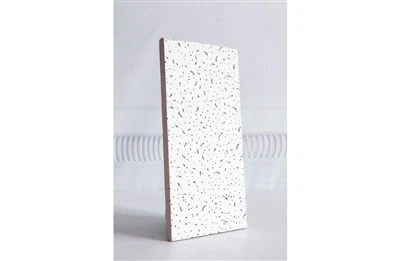
As a supplier of Square Pinhole Mineral Fiber Board, I often encounter inquiries regarding the bending strength of this remarkable building material. Bending strength is a crucial property that determines the board's ability to withstand forces without breaking or deforming under load. In this blog post, I will delve into the concept of bending strength, factors affecting it in Square Pinhole Mineral Fiber Boards, and its significance in various applications.
Understanding Bending Strength
Bending strength, also known as flexural strength, refers to the maximum stress a material can withstand when subjected to a bending load before it fails. It is typically measured in units of force per unit area, such as pounds per square inch (psi) or megapascals (MPa). When a Square Pinhole Mineral Fiber Board is placed under a bending load, it experiences tension on one side and compression on the other. The bending strength of the board is determined by its ability to resist these internal stresses without fracturing.
Factors Affecting Bending Strength
Several factors influence the bending strength of Square Pinhole Mineral Fiber Boards. These include the composition of the board, its density, manufacturing process, and the presence of any defects or irregularities.
Composition
Square Pinhole Mineral Fiber Boards are typically made from a combination of mineral fibers, binders, and additives. The type and quality of these materials play a significant role in determining the board's bending strength. High-quality mineral fibers with good tensile strength contribute to a stronger board, while the binder helps hold the fibers together and provides additional strength and durability.
Density
The density of a Square Pinhole Mineral Fiber Board is another important factor affecting its bending strength. Generally, higher density boards tend to have greater bending strength because they contain more material per unit volume, which can resist bending forces more effectively. However, it is important to note that density alone does not guarantee high bending strength, as other factors such as fiber orientation and binder quality also play a role.
Manufacturing Process
The manufacturing process used to produce Square Pinhole Mineral Fiber Boards can also impact their bending strength. Boards that are manufactured using advanced techniques, such as high-pressure pressing and precise control of fiber orientation, are likely to have better bending strength compared to those produced using less sophisticated methods. Additionally, proper curing and drying of the boards during the manufacturing process are essential to ensure optimal strength and durability.
Defects and Irregularities
The presence of defects or irregularities in a Square Pinhole Mineral Fiber Board can significantly reduce its bending strength. These defects may include cracks, voids, or uneven distribution of fibers, which can create stress concentration points and weaken the board's structure. Therefore, it is important to carefully inspect the boards for any signs of damage or imperfections before installation.
Significance of Bending Strength in Applications
The bending strength of Square Pinhole Mineral Fiber Boards is a critical consideration in various applications, including ceiling and wall installations, partitions, and acoustic panels.
Ceiling and Wall Installations
In ceiling and wall applications, Square Pinhole Mineral Fiber Boards are often subjected to bending forces due to their own weight, as well as the weight of any additional fixtures or equipment that may be attached to them. Boards with high bending strength are able to support these loads without sagging or breaking, ensuring a stable and long-lasting installation.
Partitions
Partitions made from Square Pinhole Mineral Fiber Boards are commonly used to divide large spaces into smaller, more functional areas. These partitions may be subjected to lateral forces, such as people leaning against them or doors slamming, which can cause bending stress. Boards with sufficient bending strength are able to withstand these forces without deformation, maintaining the integrity of the partition.
Acoustic Panels
Acoustic panels made from Square Pinhole Mineral Fiber Boards are designed to absorb sound and reduce noise levels in a room. These panels are often installed on walls or ceilings and may be subjected to bending forces during installation or due to environmental factors. Boards with good bending strength are able to maintain their shape and performance over time, providing effective sound absorption.
Testing Bending Strength
To ensure the quality and performance of Square Pinhole Mineral Fiber Boards, it is important to conduct regular testing of their bending strength. This can be done using standardized testing methods, such as ASTM C367 or ISO 12460-3, which specify the procedures for measuring the flexural strength of fiber cement products.
During the testing process, a sample of the board is placed on two supports and a load is applied at the center until the board fails. The maximum load that the board can withstand before failure is recorded, and the bending strength is calculated based on the dimensions of the sample and the applied load.


Comparison with Other Mineral Fiber Boards
Square Pinhole Mineral Fiber Boards offer several advantages over other types of mineral fiber boards, such as Square Fine Fissure Mineral Fiber Board and Square Sand Mineral Fiber Board. While the specific bending strength may vary depending on the product and manufacturer, Square Pinhole Mineral Fiber Boards generally have a good balance of strength, durability, and acoustic performance.
Compared to Tegular Fine Fissure Mineral Fiber Board, Square Pinhole Mineral Fiber Boards may offer different aesthetic options and installation methods, but they can also provide similar levels of bending strength and performance in many applications.
Conclusion
In conclusion, the bending strength of Square Pinhole Mineral Fiber Boards is an important property that determines their suitability for various applications. By understanding the factors that affect bending strength and conducting regular testing, we can ensure that our boards meet the highest standards of quality and performance.
If you are interested in learning more about Square Pinhole Mineral Fiber Boards or would like to discuss your specific requirements, please feel free to contact us. Our team of experts is available to provide you with detailed information and assistance in selecting the right product for your project. We look forward to the opportunity to work with you and help you achieve your goals.
References
- ASTM C367 - Standard Test Methods for Flexural Properties of Fiber - Cement Flat Sheets, Roofing, Siding, and Shingles.
- ISO 12460 - 3 - Wood - based panels - Determination of bending strength and modulus of elasticity in bending.