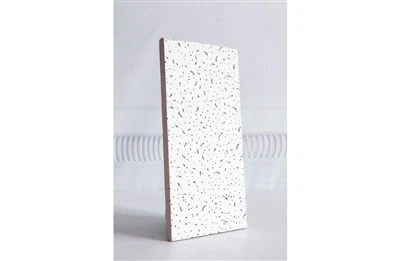
Hey there! As a supplier of sand hole mineral fiber board, I often get asked about its density. So, let's dive right into it and explore what the density of sand hole mineral fiber board is all about.
First off, what exactly is sand hole mineral fiber board? Well, it's a type of building material that's made from mineral fibers. These fibers are usually derived from rock or slag, and they're processed to create a board with a unique structure. The "sand hole" in its name refers to the small pores or holes that are present on the surface of the board, which give it some interesting properties.
Now, let's talk about density. Density is basically how much mass is packed into a given volume. In the case of sand hole mineral fiber board, density plays a crucial role in determining its performance and applications.
The density of sand hole mineral fiber board can vary depending on several factors. One of the main factors is the manufacturing process. Different manufacturers may use different techniques and raw materials, which can result in boards with different densities. Generally, the density of sand hole mineral fiber board can range from around 200 kg/m³ to 600 kg/m³.
A lower density board, say around 200 - 300 kg/m³, is usually more lightweight. This makes it easier to handle and install, especially in projects where weight is a concern. For example, if you're working on a renovation project in an older building where the structure may not be able to support a heavy load, a lower density sand hole mineral fiber board would be a great choice. It also tends to be more cost - effective, which is always a plus for budget - conscious projects.
On the other hand, a higher density board, in the range of 400 - 600 kg/m³, has its own advantages. Higher density boards are generally more durable and have better sound - insulation properties. If you're building a recording studio or a home theater, a higher density sand hole mineral fiber board can help to reduce the amount of noise that escapes or enters the room. It also offers better fire resistance, which is an important safety feature in many building applications.
Another factor that can affect the density is the intended use of the board. For ceiling applications, a medium - density board (around 300 - 400 kg/m³) is often preferred. It provides a good balance between weight, cost, and performance. It's light enough to be easily installed on the ceiling structure, yet dense enough to offer decent sound absorption and durability.
When it comes to wall applications, the choice of density depends on the specific requirements of the wall. If the wall is part of a partition in an office space, a lower density board may be sufficient. But if it's an exterior wall or a wall that needs to provide high - level soundproofing, a higher density board would be more appropriate.
Now, let's take a look at some of the benefits of using sand hole mineral fiber board based on its density.
For lightweight, low - density boards, the ease of installation is a major advantage. You don't need heavy - duty equipment or a large team of workers to install them. This can save both time and money during the construction process. They're also great for DIY projects, as they're more manageable for the average homeowner.
Higher - density boards, as mentioned earlier, offer excellent sound insulation. This is because the dense structure of the board helps to absorb and block sound waves. You can check out Mineral Fiber Board, Mineral Wool Ceiling Tiles to learn more about the different types of mineral fiber boards available and how their density affects their sound - insulating properties.
In terms of fire safety, sand hole mineral fiber board, especially the higher - density ones, has good fire - resistant capabilities. Mineral fibers are inherently non - combustible, which means they can help to prevent the spread of fire in a building. This is a critical feature in buildings where fire safety is a top priority, such as hospitals, schools, and commercial buildings.


The sand holes on the surface of the board also contribute to its performance. These holes increase the surface area of the board, which enhances its sound - absorption capabilities. They also allow for better air circulation, which can help to regulate the humidity in a room.
If you're in the market for noise - reduction solutions, NOISE REDUCTION MINERAL FIBER CEILING TILES are a great option. These tiles are designed to maximize the noise - absorbing properties of the sand hole mineral fiber board, and they come in a variety of densities to suit different needs.
Another interesting application of related products is the Embossed PVC Film For Gypsum Tile. This film can be used in combination with sand hole mineral fiber board or other building materials to enhance their aesthetic appeal and performance.
So, how do you choose the right density of sand hole mineral fiber board for your project? First, you need to clearly define your project requirements. Consider factors such as the location of the installation (ceiling, wall, etc.), the level of soundproofing needed, the weight - bearing capacity of the structure, and your budget.
If you're not sure which density is best for you, don't hesitate to reach out to us. We have a team of experts who can provide you with professional advice based on your specific situation. We can also offer samples of different density boards so that you can test their performance and see which one suits your needs the best.
In conclusion, the density of sand hole mineral fiber board is a key factor that determines its performance, cost, and suitability for different applications. Whether you need a lightweight board for easy installation or a high - density board for superior soundproofing and fire resistance, there's a sand hole mineral fiber board out there for you.
If you're interested in purchasing sand hole mineral fiber board or have any questions about our products, feel free to contact us. We're here to help you find the perfect solution for your building project.
References
- Building Materials Handbook: Mineral Fiber Products
- Construction Industry Research on Mineral Fiber Board Applications