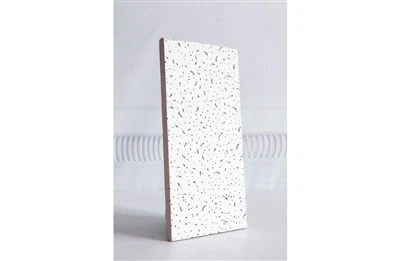
Square colors mineral fiber boards are a popular choice in the construction and interior design industries due to their aesthetic appeal, acoustic properties, and fire resistance. As a leading supplier of square colors mineral fiber boards, I often receive inquiries about their load - bearing capacity. In this blog post, I will delve into the factors that influence the load - bearing capacity of these boards, how it is determined, and its significance in various applications.
Factors Influencing the Load - Bearing Capacity
Material Composition
The load - bearing capacity of square colors mineral fiber boards is primarily determined by their material composition. These boards are typically made from mineral fibers, such as rock wool or slag wool, which are bound together with a resin binder. The quality and type of mineral fibers used play a crucial role. High - quality fibers with uniform thickness and length can distribute the load more evenly, resulting in a higher load - bearing capacity. Additionally, the type and amount of resin binder affect the board's strength. A well - formulated binder can enhance the cohesion between the fibers, increasing the overall structural integrity of the board.
Board Density
Density is another significant factor. Generally, higher - density square colors mineral fiber boards have a greater load - bearing capacity. A denser board has more fibers packed closely together, which provides more resistance to deformation under load. However, it's important to note that increasing the density also has implications for other properties of the board, such as its weight and acoustic performance. A very high - density board may be too heavy for some applications and may not offer the desired acoustic absorption.


Board Thickness
Thicker square colors mineral fiber boards tend to have a higher load - bearing capacity. As the thickness increases, the board can better resist bending and deflection when subjected to a load. This is because a thicker cross - section provides more material to distribute the load, reducing the stress on any single point of the board.
Manufacturing Process
The manufacturing process can also impact the load - bearing capacity. Boards that are manufactured under precise conditions, with proper curing and pressing, are likely to have a more consistent and higher load - bearing capacity. For example, if the pressing process is not uniform, it can lead to areas of weakness in the board, which may reduce its overall strength.
Determining the Load - Bearing Capacity
Laboratory Testing
To accurately determine the load - bearing capacity of square colors mineral fiber boards, laboratory testing is essential. One common method is the point load test, where a concentrated load is applied at a specific point on the board until it fails. The maximum load that the board can withstand before failure is recorded as its point load - bearing capacity. Another method is the uniformly distributed load test, where a load is evenly distributed across the surface of the board. This test simulates real - world scenarios where the board may be supporting a continuous weight, such as in a ceiling application.
Industry Standards
There are industry standards and codes that govern the load - bearing capacity of building materials, including square colors mineral fiber boards. These standards ensure that the boards meet minimum safety requirements for different applications. For example, in ceiling installations, the load - bearing capacity of the board must be sufficient to support its own weight, as well as any additional loads such as lighting fixtures, ventilation ducts, or sprinkler systems.
Significance in Different Applications
Ceiling Applications
In ceiling applications, the load - bearing capacity of square colors mineral fiber boards is of utmost importance. Ceilings need to support not only the weight of the board itself but also any fixtures or equipment that are attached to them. A board with a low load - bearing capacity may sag or even collapse under the weight, posing a safety hazard. Our Tegular Fine Fissure Mineral Fiber Board is designed with a sufficient load - bearing capacity to meet the requirements of most ceiling installations, providing a safe and aesthetically pleasing solution.
Wall Partitions
When used in wall partitions, square colors mineral fiber boards may need to support some lateral loads, such as the weight of wall - mounted objects or the pressure from adjacent structures. A board with an appropriate load - bearing capacity can ensure the stability of the partition. Our Mineral Fiber Board, Mineral Wool Ceiling Tiles can be used in wall partitions, offering both good load - bearing properties and excellent acoustic insulation.
Flooring Underlayment
In some cases, square colors mineral fiber boards can be used as a flooring underlayment. Here, they need to withstand the weight of the flooring material above and any foot traffic or furniture loads. Our Square Sand Hole Mineral Fiber Board can be a suitable choice for such applications, with its well - balanced load - bearing capacity and other beneficial properties.
Importance of Knowing the Load - Bearing Capacity
Safety
Ensuring that the square colors mineral fiber boards used in a project have an appropriate load - bearing capacity is crucial for safety. Using boards with a load - bearing capacity that is too low can lead to structural failures, which can cause injuries or damage to property. By understanding the load - bearing capacity, architects, contractors, and building owners can make informed decisions about the selection and installation of these boards.
Cost - Effectiveness
Knowing the load - bearing capacity can also contribute to cost - effectiveness. Selecting a board with a higher load - bearing capacity than necessary may result in unnecessary costs, as these boards are often more expensive. On the other hand, choosing a board with an insufficient load - bearing capacity can lead to costly repairs or replacements in the future.
Conclusion
The load - bearing capacity of square colors mineral fiber boards is influenced by multiple factors, including material composition, density, thickness, and manufacturing process. Laboratory testing and adherence to industry standards are essential for accurately determining this capacity. Understanding the load - bearing capacity is crucial for ensuring safety and cost - effectiveness in various applications, such as ceiling installations, wall partitions, and flooring underlayment.
As a supplier of square colors mineral fiber boards, we are committed to providing high - quality products with reliable load - bearing capacities. Our team of experts can assist you in selecting the right board for your specific project requirements. If you are interested in learning more about our products or have any questions regarding load - bearing capacity, please feel free to contact us for procurement and further discussions.
References
- ASTM International. (Year). Standard test methods for load - bearing capacity of building materials.
- National Building Code. (Year). Requirements for structural safety of building components.