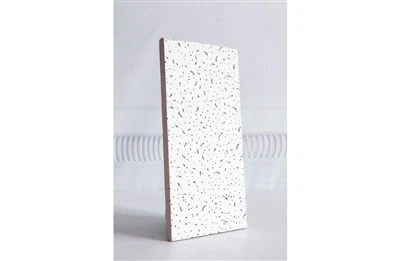
When it comes to creating a comfortable and acoustically balanced indoor environment, the choice of building materials plays a crucial role. Among the various options available, Square Pinhole Mineral Fiber Board has emerged as a popular choice for its aesthetic appeal and functional benefits. As a supplier of Square Pinhole Mineral Fiber Board, I am often asked about the sound absorption coefficient of this product. In this blog post, I will delve into the concept of sound absorption coefficient, explain how it relates to Square Pinhole Mineral Fiber Board, and discuss its implications for acoustic design.
Understanding the Sound Absorption Coefficient
The sound absorption coefficient is a measure of how effectively a material absorbs sound energy. It is expressed as a value between 0 and 1, where 0 represents a material that reflects all sound energy (like a hard, smooth surface such as glass or metal) and 1 represents a material that absorbs all sound energy (a perfect absorber). In real - world applications, most materials have a sound absorption coefficient somewhere in between these two extremes.
The sound absorption coefficient is typically measured at specific frequencies, as different materials may absorb sound more effectively at certain frequencies than others. For example, a material might be very good at absorbing high - frequency sounds but less effective at low - frequency sounds. Common frequency ranges used for testing include 125 Hz, 250 Hz, 500 Hz, 1000 Hz, 2000 Hz, and 4000 Hz.
Sound Absorption Mechanisms of Square Pinhole Mineral Fiber Board
Square Pinhole Mineral Fiber Board is made from mineral fibers, which are typically derived from natural or synthetic minerals. These fibers are formed into a board with a square - pinhole pattern on its surface. The unique structure of this board contributes to its sound - absorbing properties in several ways.
First, the porous nature of the mineral fiber material allows sound waves to enter the board. When sound waves penetrate the pores, they cause the air inside the pores to vibrate. The friction between the vibrating air molecules and the fiber surfaces converts the sound energy into heat energy, which is then dissipated. This is known as the viscous dissipation mechanism.
Second, the square - pinhole pattern on the surface of the board helps to increase the surface area available for sound absorption. The pinholes act as small resonators, which can trap and absorb sound waves at specific frequencies. When the frequency of the incoming sound wave matches the resonant frequency of the pinholes, the sound energy is efficiently absorbed.
Factors Affecting the Sound Absorption Coefficient of Square Pinhole Mineral Fiber Board
Several factors can influence the sound absorption coefficient of Square Pinhole Mineral Fiber Board.
Thickness: Generally, thicker boards tend to have higher sound absorption coefficients, especially at lower frequencies. A thicker board provides more material for the sound waves to travel through, increasing the chances of energy conversion and dissipation.
Density: The density of the mineral fiber board also plays a role. A higher - density board may have better sound absorption at high frequencies, while a lower - density board can be more effective at low frequencies. However, there is an optimal density range for achieving the best overall sound absorption performance across different frequencies.
Pinhole Size and Pattern: The size and pattern of the square pinholes on the board's surface can significantly affect the sound absorption. Different pinhole sizes can resonate at different frequencies, allowing for tailored sound absorption. For example, smaller pinholes are more effective at absorbing high - frequency sounds, while larger pinholes can target lower - frequency sounds.
Typical Sound Absorption Coefficient Values of Square Pinhole Mineral Fiber Board
The sound absorption coefficient of Square Pinhole Mineral Fiber Board can vary depending on the specific product and its design. On average, a well - designed Square Pinhole Mineral Fiber Board can have a sound absorption coefficient of around 0.6 - 0.9 at mid - frequencies (500 Hz - 2000 Hz). At low frequencies (125 Hz - 250 Hz), the coefficient might be around 0.2 - 0.5, and at high frequencies (2000 Hz - 4000 Hz), it can reach 0.8 - 0.9.
It's important to note that these values are approximate and can be verified through laboratory testing. Manufacturers usually provide detailed acoustic performance data for their products, which can be used by architects, designers, and contractors to select the most suitable board for their specific acoustic requirements.
Applications of Square Pinhole Mineral Fiber Board Based on Sound Absorption
Due to its good sound absorption properties, Square Pinhole Mineral Fiber Board is widely used in various applications where acoustic control is important.
Commercial Buildings: In offices, conference rooms, and auditoriums, Square Pinhole Mineral Fiber Board can be used on ceilings and walls to reduce reverberation time and improve speech intelligibility. By absorbing excess sound energy, it creates a more comfortable and productive working and meeting environment.
Educational Institutions: Classrooms, libraries, and lecture halls can benefit from the installation of Square Pinhole Mineral Fiber Board. It helps to minimize background noise and distractions, allowing students and teachers to focus better.
Entertainment Venues: Cinemas, theaters, and music studios require precise acoustic control. Square Pinhole Mineral Fiber Board can be used to create a balanced acoustic environment, enhancing the quality of sound reproduction and the overall entertainment experience.
Comparing Square Pinhole Mineral Fiber Board with Other Sound - Absorbing Materials
When compared with other common sound - absorbing materials such as Mineral Fiber Board, Mineral Wool Ceiling Tiles and Square Colors Mineral Fiber Board, Square Pinhole Mineral Fiber Board offers several advantages.


Compared to traditional mineral fiber boards without the square - pinhole pattern, Square Pinhole Mineral Fiber Board can provide better sound absorption at specific frequencies due to the resonator effect of the pinholes. It also has a more unique and aesthetically pleasing appearance, which can enhance the interior design of a space.
In comparison to other materials like foam or fiberglass insulation, Square Pinhole Mineral Fiber Board is more fire - resistant and environmentally friendly. Mineral fibers are non - combustible, making them a safer choice for building applications.
Conclusion
The sound absorption coefficient of Square Pinhole Mineral Fiber Board is an important parameter that determines its effectiveness in acoustic applications. Through its unique structure of mineral fibers and square pinholes, this board can achieve good sound absorption across a wide range of frequencies. Factors such as thickness, density, and pinhole size can be optimized to meet specific acoustic requirements.
If you are in the process of designing or renovating a space that requires acoustic control, Square Pinhole Mineral Fiber Board is a great option to consider. Its combination of functional performance and aesthetic appeal makes it a versatile choice for various commercial, educational, and entertainment applications.
If you are interested in learning more about our Square Pinhole Mineral Fiber Board or have specific acoustic requirements for your project, please feel free to contact us. We are happy to provide you with detailed product information, technical support, and assistance in selecting the most suitable board for your needs. Let's work together to create a more acoustically comfortable and beautiful indoor environment.
References
- Beranek, Leo L. "Acoustics." American Institute of Physics, 1954.
- Fahy, Frank J. "Foundations of Engineering Acoustics." Academic Press, 2001.
- Kryter, Karl D. "The Handbook of Hearing and the Effects of Noise: Physiology, Psychology, and Public Health." Academic Press, 1994.