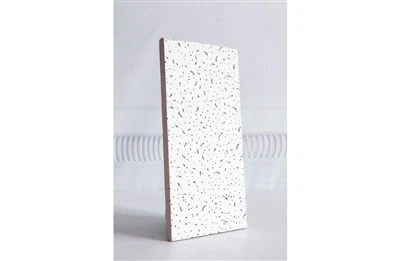
As a supplier of square pinhole mineral fiber tiles, I often encounter inquiries about the sound - absorption coefficient of our products at different frequencies. Understanding this characteristic is crucial for customers who are looking to create acoustically optimized spaces, whether it's an office, a theater, or a classroom. In this blog, I will delve into the concept of sound - absorption coefficient, how it relates to square pinhole mineral fiber tiles, and the performance of our tiles at various frequencies.
Understanding the Sound - Absorption Coefficient
The sound - absorption coefficient is a metric that measures how effectively a material can absorb sound energy. It is expressed on a scale from 0 to 1. A coefficient of 0 means that the material reflects all the sound energy, while a coefficient of 1 indicates that the material absorbs all the sound energy. Different materials have different sound - absorption coefficients, and these coefficients can vary depending on the frequency of the sound.
Sound is a complex phenomenon composed of different frequencies. The frequency of a sound wave is measured in Hertz (Hz) and determines the pitch of the sound. Low - frequency sounds, such as those from a bass drum, typically range from 20 Hz to 200 Hz. Mid - frequency sounds, which are common in human speech, fall in the range of 200 Hz to 2000 Hz. High - frequency sounds, like the chirping of a bird, can go above 2000 Hz.
The Design and Properties of Square Pinhole Mineral Fiber Tiles
Our square pinhole mineral fiber tiles are designed with a unique surface structure. The numerous square pinholes on the surface play a vital role in sound absorption. When sound waves hit the tile, they enter these pinholes. Inside the pinholes, the sound energy is converted into heat energy through friction with the walls of the holes and the mineral fiber material.
The mineral fiber used in our tiles is a high - quality, environmentally friendly material. It has a porous internal structure that further enhances its sound - absorption capabilities. The combination of the surface pinholes and the internal porosity makes our square pinhole mineral fiber tiles excellent candidates for sound - absorbing applications.
Sound - Absorption Coefficient at Different Frequencies
Low Frequencies (20 Hz - 200 Hz)
At low frequencies, sound waves have longer wavelengths. Our square pinhole mineral fiber tiles generally have a relatively lower sound - absorption coefficient in this frequency range. The long - wavelength sound waves are less likely to be affected by the small - scale pinholes on the tile surface. However, the internal porous structure of the mineral fiber still contributes to some degree of sound absorption. Through testing, we have found that our tiles can achieve a sound - absorption coefficient of around 0.2 - 0.3 at frequencies in the low - end range.
Mid Frequencies (200 Hz - 2000 Hz)
The mid - frequency range is where our square pinhole mineral fiber tiles truly shine. The size of the pinholes and the internal porosity work together to effectively absorb these frequencies. Human speech mainly falls within this range, so for applications where clear communication is essential, such as offices and classrooms, our tiles are an ideal choice. In the mid - frequency range, the sound - absorption coefficient of our tiles can reach up to 0.8 - 0.9. This high coefficient means that a large proportion of the mid - frequency sound energy is absorbed, reducing echo and reverberation in the space.
High Frequencies (above 2000 Hz)
High - frequency sound waves have shorter wavelengths. The square pinholes on the tile surface are very effective at capturing these short - wavelength waves. As a result, our square pinhole mineral fiber tiles have an excellent sound - absorption coefficient at high frequencies. Typically, the coefficient can be as high as 0.9 or even close to 1 in some cases. This makes our tiles very suitable for environments where high - frequency noise needs to be controlled, such as recording studios.
Real - World Applications
The unique sound - absorption characteristics of our square pinhole mineral fiber tiles make them versatile in various real - world applications.
In office buildings, the high sound - absorption coefficient in the mid - frequency range helps to reduce the background noise from conversations and office equipment. This creates a more peaceful and productive working environment. Workers can focus better on their tasks without being distracted by excessive noise.
For theaters and concert halls, the ability to absorb both mid - and high - frequency sounds is crucial. It helps to enhance the clarity of the performance, allowing the audience to enjoy a more immersive audio experience. The reduction of echo and reverberation ensures that every note and word is heard clearly.
In classrooms, the sound - absorbing properties of our tiles are beneficial for both teachers and students. Clear communication is essential for effective learning, and the tiles help to minimize distractions caused by external noise and internal echoes.
The Advantages of Our Square Pinhole Mineral Fiber Tiles
Apart from their excellent sound - absorption performance, our square pinhole mineral fiber tiles have several other advantages.
They are fire - resistant. The mineral fiber material used in the tiles has inherent fire - resistant properties, which can provide an extra layer of safety in case of a fire. This is especially important in public buildings and commercial spaces.
The tiles are also easy to install. With their standard square size, they can be easily fitted into a suspended ceiling system. This makes the installation process quick and efficient, reducing the overall construction time.
In addition, our square pinhole mineral fiber tiles are aesthetically pleasing. The square pinhole pattern gives them a modern and unique look that can enhance the overall interior design of a space.
How to Choose the Right Tiles for Your Needs
When choosing square pinhole mineral fiber tiles, it's important to consider the specific sound - absorption requirements of your project. If you are in a space with a lot of low - frequency noise, you may need to combine our tiles with other sound - absorbing materials that are more effective at low frequencies.
If your main concern is mid - frequency noise, such as human speech, then our tiles can provide excellent results on their own. For high - frequency noise control, our tiles are a great option due to their high sound - absorption coefficient at high frequencies.


Conclusion
In conclusion, our square pinhole mineral fiber tiles offer a high - performance solution for sound absorption at different frequencies. Their unique design and material properties make them suitable for a wide range of applications, from offices to theaters and classrooms. With excellent sound - absorption capabilities, fire - resistance, ease of installation, and aesthetic appeal, our tiles are a great choice for any project that requires acoustic treatment.
If you are interested in our Square Sand Hole Mineral Fiber Board, you can also explore our broader range of Mineral Fiber Ceiling Tiles/Board. We are a Mineral Fiber Ceiling Tiles/Board Factory dedicated to providing high - quality products. If you have any questions or are interested in purchasing our square pinhole mineral fiber tiles, feel free to contact us for further discussion and negotiation. We look forward to working with you to create the perfect acoustically optimized space.
References
- Beranek, Leo L. "Acoustics." American Institute of Physics, 1954.
- Crocker, Malcolm J., ed. "Handbook of Noise and Vibration Control." John Wiley & Sons, 2007.