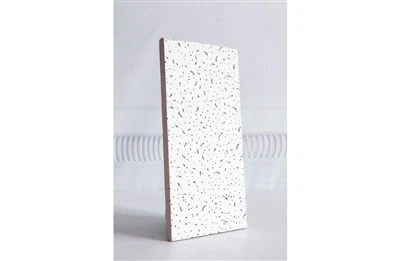
As a supplier of acoustic mineral fiber boards, I often encounter questions from customers regarding the thickness range of these boards. Understanding the appropriate thickness is crucial as it directly impacts the acoustic performance, installation requirements, and overall suitability for different applications. In this blog, I'll delve into the typical thickness range of acoustic mineral fiber boards, factors influencing the choice of thickness, and how it relates to various uses.
Typical Thickness Range
Acoustic mineral fiber boards are available in a variety of thicknesses to meet different needs. Generally, the thickness range of these boards spans from as thin as 6mm to as thick as 25mm. Each thickness within this range serves specific purposes and offers distinct advantages.
-
6 - 10mm: Boards in this thinner range are often used in applications where space is limited or where a lightweight solution is required. For instance, in retrofit projects where the existing structure may not support heavy loads, 6 - 10mm acoustic mineral fiber boards can be a great choice. They are also suitable for interior partitions where the primary goal is to reduce noise transmission to a moderate level. These thinner boards are relatively easy to handle and install, making them a popular option for DIY projects. You can explore our Square Sand Hole Mineral Fiber Board, which is available in some thinner thicknesses, for such applications.
-
12 - 18mm: This is the most commonly used thickness range for acoustic mineral fiber boards. Boards in this range offer a good balance between acoustic performance and structural integrity. They are suitable for a wide range of applications, including commercial buildings such as offices, restaurants, and auditoriums. In these settings, they can effectively absorb sound, reducing reverberation and creating a more comfortable acoustic environment. For example, in an office space, 12 - 18mm boards can help minimize distractions caused by conversations and equipment noise. Our Mineral Fiber Ceiling Boards & Tiles are available in this thickness range and are ideal for ceiling installations in such commercial spaces.
-
20 - 25mm: Thicker boards in this range are designed for applications where high - level acoustic performance is required. They are often used in recording studios, concert halls, and other professional audio environments. The increased thickness allows for greater sound absorption, reducing the reflection of sound waves and ensuring a more accurate acoustic reproduction. These boards can also provide better fire resistance and thermal insulation properties. Our Square Sand Mineral Fiber Board is available in some of these thicker options for demanding applications.
Factors Influencing Thickness Selection
Several factors come into play when choosing the appropriate thickness of acoustic mineral fiber boards:
-
Acoustic Requirements: The primary consideration is the desired level of sound absorption. If the goal is to achieve a high Noise Reduction Coefficient (NRC), thicker boards are generally preferred. For example, a recording studio may require an NRC of 0.9 or higher, which can be more easily achieved with 20 - 25mm boards. On the other hand, a simple office partition may only need an NRC of 0.5 - 0.7, which can be achieved with 12 - 18mm boards.
-
Installation Location: The location where the boards will be installed also affects the thickness choice. Ceiling installations may require lighter boards to reduce the load on the ceiling structure, so 6 - 18mm boards are more common. Wall installations, especially in areas with high noise levels, may benefit from thicker boards for better sound insulation.
-
Budget: Thicker boards are generally more expensive than thinner ones. Therefore, budget constraints can be a significant factor in the decision - making process. It's important to find a balance between the desired acoustic performance and the available budget.
Applications and Thickness Recommendations
-
Residential Use: In homes, acoustic mineral fiber boards can be used in bedrooms, living rooms, and home theaters. For bedrooms and living rooms, 12 - 18mm boards are usually sufficient to reduce noise from outside and between rooms. In a home theater, where high - quality sound is crucial, 20 - 25mm boards can be used to create an immersive audio experience.
-
Commercial Use: As mentioned earlier, offices, restaurants, and auditoriums typically use 12 - 18mm boards. However, in large auditoriums or conference centers, thicker boards may be necessary to ensure uniform sound distribution and high - quality acoustics.


-
Industrial Use: In industrial settings, such as factories and warehouses, where noise levels can be extremely high, 20 - 25mm boards are often used to protect workers from excessive noise exposure and to comply with safety regulations.
Conclusion
The thickness range of acoustic mineral fiber boards is diverse, offering solutions for a wide range of applications. Whether you need a lightweight and cost - effective option for a small project or a high - performance board for a professional audio environment, there is a suitable thickness available. As a supplier, we are committed to providing high - quality acoustic mineral fiber boards in various thicknesses to meet your specific needs.
If you are interested in purchasing acoustic mineral fiber boards or have any questions about the appropriate thickness for your project, please feel free to contact us for a detailed consultation. We look forward to working with you to create the perfect acoustic solution.
References
- Acoustical Society of America. "Acoustic Design Guidelines for Buildings."
- International Building Code. "Sound Insulation Requirements."