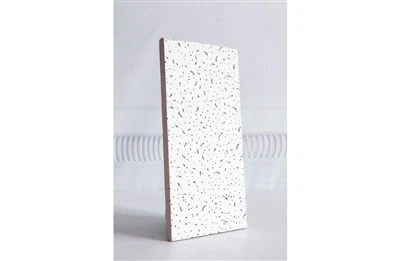
What is the Young's modulus of sand acoustic mineral fiber board?
As a supplier of sand acoustic mineral fiber boards, I often encounter inquiries from customers about various technical properties of our products. One question that comes up quite frequently is about the Young's modulus of sand acoustic mineral fiber board. In this blog post, I'll delve into what Young's modulus is, its significance for sand acoustic mineral fiber boards, and how it impacts the performance of these boards.
Understanding Young's Modulus
Young's modulus, also known as the elastic modulus, is a fundamental mechanical property that measures the stiffness of a material. It is defined as the ratio of stress (force per unit area) to strain (deformation per unit length) within the elastic range of a material. In simpler terms, it tells us how much a material will stretch or compress when a certain amount of force is applied to it. The formula for Young's modulus (E) is given by:
[E=\frac{\sigma}{\epsilon}]
where (\sigma) is the stress and (\epsilon) is the strain.
The unit of Young's modulus is typically pascals (Pa) in the SI system. A high Young's modulus indicates that a material is stiff and requires a large amount of force to produce a small amount of deformation. Conversely, a low Young's modulus means that the material is more flexible and can be easily deformed under a relatively small force.
Young's Modulus of Sand Acoustic Mineral Fiber Board
Sand acoustic mineral fiber boards are composite materials made from a combination of sand, mineral fibers, and other additives. These boards are widely used in the construction industry for acoustic insulation, ceiling applications, and wall cladding due to their excellent sound absorption properties, fire resistance, and lightweight nature.
The Young's modulus of sand acoustic mineral fiber board can vary depending on several factors, including the composition of the board, the density of the fibers, and the manufacturing process. Generally, the Young's modulus of sand acoustic mineral fiber board ranges from a few hundred megapascals (MPa) to a few gigapascals (GPa).
For example, a typical sand acoustic mineral fiber board with a medium density may have a Young's modulus of around 500 MPa to 1 GPa. This value indicates that the board is relatively stiff and can withstand a certain amount of mechanical stress without significant deformation. However, it is important to note that the actual Young's modulus of a specific board may deviate from this range depending on the specific product and its manufacturing conditions.
Significance of Young's Modulus for Sand Acoustic Mineral Fiber Board
The Young's modulus of sand acoustic mineral fiber board plays a crucial role in determining its performance and suitability for different applications. Here are some key aspects where Young's modulus is important:


- Structural Integrity: A higher Young's modulus means that the board is stiffer and can better maintain its shape and structural integrity under load. This is particularly important in ceiling applications where the board needs to support its own weight as well as any additional loads such as lighting fixtures or HVAC equipment.
- Acoustic Performance: The stiffness of the board, as determined by its Young's modulus, can also affect its acoustic performance. A stiffer board is less likely to vibrate in response to sound waves, which can help to reduce sound transmission and improve the overall acoustic insulation of the space.
- Installation and Handling: The Young's modulus of the board can influence its ease of installation and handling. A board with a higher Young's modulus may be more brittle and prone to cracking or breaking during installation, while a board with a lower Young's modulus may be more flexible and easier to work with.
Factors Affecting the Young's Modulus of Sand Acoustic Mineral Fiber Board
As mentioned earlier, several factors can affect the Young's modulus of sand acoustic mineral fiber board. Here are some of the main factors:
- Fiber Content and Orientation: The amount and orientation of the mineral fibers in the board can have a significant impact on its Young's modulus. Generally, a higher fiber content and a more aligned fiber orientation result in a higher Young's modulus.
- Density: The density of the board is another important factor. A higher density board typically has a higher Young's modulus because it contains more material per unit volume, which makes it stiffer.
- Additives and Binders: The type and amount of additives and binders used in the manufacturing process can also affect the Young's modulus of the board. Some additives can enhance the stiffness of the board, while others may have the opposite effect.
- Manufacturing Process: The manufacturing process, including the pressing and curing conditions, can influence the structure and properties of the board. A well-controlled manufacturing process can result in a board with a more uniform and consistent Young's modulus.
Comparison with Other Materials
To better understand the Young's modulus of sand acoustic mineral fiber board, it is useful to compare it with other common building materials. Here is a table showing the approximate Young's modulus values of some materials:
| Material | Young's Modulus (GPa) |
|---|---|
| Steel | 200 |
| Concrete | 20 - 40 |
| Wood | 10 - 20 |
| Sand Acoustic Mineral Fiber Board | 0.5 - 1 |
As can be seen from the table, sand acoustic mineral fiber board has a relatively low Young's modulus compared to steel and concrete. This makes it a more flexible and lightweight material, which is advantageous in many applications where weight and ease of installation are important considerations.
Applications of Sand Acoustic Mineral Fiber Board
Sand acoustic mineral fiber boards are used in a wide range of applications due to their unique combination of properties. Some of the common applications include:
- Ceiling Tiles: Sand acoustic mineral fiber ceiling tiles are popular for their excellent sound absorption properties and aesthetic appeal. They can be used in commercial buildings, offices, schools, and other public spaces to improve the acoustic environment. Mineral Fiber Ceiling Tiles
- Wall Cladding: The boards can also be used as wall cladding to provide acoustic insulation and enhance the visual appearance of the space. They are available in a variety of colors and textures to suit different design requirements.
- Partition Walls: Sand acoustic mineral fiber boards can be used to construct partition walls in offices, hotels, and other buildings. These walls help to reduce sound transmission between different rooms and provide a more private and comfortable environment.
- Embossed PVC Film For Gypsum Tile: In some cases, sand acoustic mineral fiber boards can be combined with Embossed PVC Film For Gypsum Tile to create a more decorative and functional product. The embossed PVC film can add a unique texture and appearance to the board, while also providing additional protection and durability.
- Tegular Pinhole Mineral Fiber Board: Tegular Pinhole Mineral Fiber Board is another type of sand acoustic mineral fiber board that is commonly used in ceiling applications. The tegular edges and pinhole pattern of the board can enhance its acoustic performance and aesthetic appeal.
Conclusion
In conclusion, the Young's modulus of sand acoustic mineral fiber board is an important mechanical property that determines its stiffness, structural integrity, and acoustic performance. Understanding the factors that affect the Young's modulus of the board can help in selecting the right product for different applications. As a supplier of sand acoustic mineral fiber boards, we are committed to providing high-quality products with consistent and reliable properties.
If you are interested in purchasing sand acoustic mineral fiber boards or have any questions about our products, please feel free to contact us for more information. We would be happy to assist you in finding the best solution for your specific needs.
References
- Callister, W. D., & Rethwisch, D. G. (2011). Materials Science and Engineering: An Introduction. Wiley.
- Ashby, M. F. (2011). Materials Selection in Mechanical Design. Butterworth-Heinemann.
- Gibson, L. J., & Ashby, M. F. (1997). Cellular Solids: Structure and Properties. Cambridge University Press.