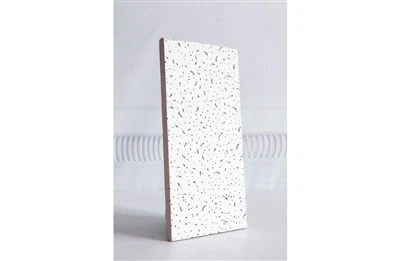
As a supplier of fine fissure mineral fiber board, I am often asked about the seismic - resistance features of this product. In this blog post, I will delve into the various aspects of how fine fissure mineral fiber board performs under seismic conditions, providing you with a comprehensive understanding of its capabilities.
1. Material Composition and Structural Integrity
Fine fissure mineral fiber board is primarily made from inorganic mineral fibers, which are known for their high strength and stability. These fibers are bonded together using special binders, creating a dense and uniform structure. The unique fine - fissure design on the surface of the board not only enhances its aesthetic appeal but also plays a crucial role in its seismic - resistance.
The fine fissures act as stress - relief channels. When an earthquake occurs, the seismic waves generate complex stress patterns in the building structure. The fine fissures in the mineral fiber board can absorb and dissipate a significant amount of this stress. Instead of the stress concentrating in one area and causing the board to crack or break, the fissures allow the stress to be distributed more evenly throughout the board. This helps to maintain the structural integrity of the board and reduces the risk of catastrophic failure.
In addition, the inorganic nature of the mineral fibers makes the board resistant to corrosion, aging, and environmental factors. This means that over time, the board will not lose its seismic - resistance properties due to deterioration. It can provide long - term protection for buildings in earthquake - prone areas.
2. Flexibility and Energy Absorption
One of the key factors in seismic - resistance is the ability of a material to flex and absorb energy. Fine fissure mineral fiber board has a certain degree of flexibility, which allows it to deform slightly under seismic forces without breaking. When an earthquake shakes a building, the board can bend and stretch in response to the movement, absorbing the kinetic energy of the seismic waves.


This energy absorption is crucial because it reduces the amount of energy transferred to the rest of the building structure. By dissipating the seismic energy within the board itself, the overall stress on the building's frame and other components is reduced. This can prevent structural damage, such as cracks in the walls or collapse of partitions, and help to keep the building standing during an earthquake.
Compared to more rigid materials, such as traditional plasterboard, fine fissure mineral fiber board's flexibility gives it an advantage in seismic - prone regions. It can adapt to the dynamic movements caused by earthquakes and provide a more reliable form of protection.
3. Lightweight and Reduced Load on the Building
Another important aspect of seismic - resistance is the weight of the building materials. Heavier materials can increase the inertia of a building, making it more difficult to withstand seismic forces. Fine fissure mineral fiber board is a lightweight material, which helps to reduce the overall load on the building structure.
When a building is lighter, it is less likely to experience excessive stress during an earthquake. The reduced weight means that the seismic forces acting on the building are also relatively smaller. This can significantly improve the building's seismic performance and reduce the risk of structural failure.
In addition, the lightweight nature of the board makes it easier to install. It can be quickly and efficiently mounted on the building's frame, reducing construction time and labor costs. This is especially beneficial in areas where rapid construction is needed, such as after an earthquake to rebuild damaged structures.
4. Compatibility with Building Structures
Fine fissure mineral fiber board is highly compatible with various building structures. It can be used in both new construction and retrofit projects. Whether it is a residential building, commercial building, or industrial facility, the board can be easily integrated into the existing or planned structure.
For example, in steel - frame buildings, the board can be attached to the steel columns and beams using appropriate fasteners. Its flexibility allows it to follow the movement of the steel structure during an earthquake, providing continuous protection. In concrete buildings, the board can be used as an interior partition or wall cladding, enhancing the seismic - resistance of the building's interior spaces.
Moreover, the board can be combined with other seismic - resistant materials, such as dampers and braces, to create a more comprehensive seismic - protection system. This compatibility makes it a versatile choice for architects, engineers, and builders in earthquake - prone areas.
5. Comparison with Other Mineral Fiber Boards
There are several types of mineral fiber boards available in the market, such as Square Pinhole Mineral Fiber Board, Square Colors Mineral Fiber Board, and Mineral Wool Board. While all these boards have certain seismic - resistance features, fine fissure mineral fiber board has some unique advantages.
Square pinhole mineral fiber board, as the name suggests, has square - shaped pinholes on its surface. These pinholes can also contribute to stress distribution to some extent, but the fine fissures in our fine fissure mineral fiber board provide a more continuous and effective stress - relief mechanism. The fine fissures cover a larger area of the board and can better adapt to different stress directions.
Square colors mineral fiber board is mainly known for its aesthetic appeal with various colors. However, in terms of seismic - resistance, the fine fissure design of our board gives it a stronger ability to absorb and dissipate seismic energy. The fine fissures are more effective in reducing stress concentration and preventing cracking.
Mineral wool board is a common type of insulation material. While it has some structural strength, the fine fissure mineral fiber board is specifically designed with seismic - resistance in mind. Its unique fine - fissure structure and optimized material composition make it a better choice for areas where seismic protection is a priority.
Conclusion
In conclusion, fine fissure mineral fiber board has excellent seismic - resistance features due to its material composition, flexibility, lightweight nature, compatibility with building structures, and unique fine - fissure design. It can effectively absorb and dissipate seismic energy, reduce stress on the building structure, and maintain its integrity during an earthquake.
If you are involved in a construction project in an earthquake - prone area, or if you are looking to retrofit an existing building to improve its seismic - resistance, I highly recommend considering fine fissure mineral fiber board. Our company offers high - quality fine fissure mineral fiber board products that can meet your specific requirements. Please feel free to contact us to discuss your procurement needs and start a productive business negotiation.
References
- "Seismic Design of Buildings" by Applied Technology Council
- "Building Materials and Their Selection" by various authors in the field of civil engineering
- Industry research reports on mineral fiber board performance in seismic conditions.