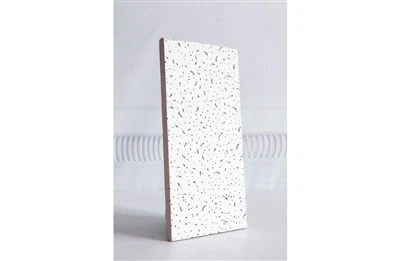
Hey there! As a supplier of sand hole mineral fiber boards, I've been getting a lot of questions lately about how to boost the flexural strength of these boards. Well, you're in luck because I'm here to share some tips and tricks that I've picked up over the years.
First off, let's talk about what flexural strength actually means. In simple terms, it's the ability of a material to resist bending or breaking when a load is applied to it. For sand hole mineral fiber boards, having good flexural strength is crucial, especially if they're going to be used in applications where they'll be subjected to some stress, like ceilings or partitions.
1. Material Selection
The quality of the raw materials you use is the foundation of a strong sand hole mineral fiber board. When it comes to the mineral fibers, go for high - grade ones. Higher - quality fibers tend to have better physical properties, such as longer lengths and more uniform diameters. Longer fibers can form a more interwoven network within the board, which helps distribute the load more evenly when stress is applied.
For the binders, choose ones that have good adhesion properties. The binder is what holds the mineral fibers together, and a strong binder can significantly enhance the overall strength of the board. Some common binders used in sand hole mineral fiber boards include synthetic resins. Make sure to test different binders to see which one works best with your specific type of mineral fibers. You can check out Mineral Fiber Ceiling Tiles/Board to get an idea of the quality materials that can be used in these boards.
2. Manufacturing Process Optimization
The manufacturing process plays a huge role in determining the flexural strength of the sand hole mineral fiber board. One important step is the forming process. During this stage, it's essential to ensure that the fibers are evenly distributed throughout the board. Uneven fiber distribution can lead to weak spots in the board, which can significantly reduce its flexural strength.
Controlling the density of the board is also crucial. A higher density generally means better flexural strength, but there's a limit. If the density is too high, the board may become too heavy and brittle. You need to find the sweet spot for your specific application. Adjusting the pressure and temperature during the pressing stage can help control the density.
Another aspect is the curing process. Proper curing allows the binder to fully set and bond the fibers together. If the curing is not done correctly, the binder may not reach its maximum strength, which will affect the overall flexural strength of the board.
3. Additives
Adding certain additives can also improve the flexural strength of sand hole mineral fiber boards. One such additive is glass fibers. Glass fibers are known for their high strength and stiffness. When added to the mineral fiber mixture, they can reinforce the board and increase its ability to resist bending.


There are also some chemical additives that can enhance the bonding between the fibers and the binder. These additives can improve the adhesion at the fiber - binder interface, which in turn boosts the flexural strength. However, it's important to use these additives in the right proportions. Too much of an additive can have a negative impact on other properties of the board, such as its fire - resistance or acoustic performance.
4. Post - Treatment
After the board is manufactured, some post - treatments can be applied to increase its flexural strength. One common post - treatment is surface coating. A hard and durable coating on the surface of the board can protect it from damage and also help distribute the load more effectively.
Heat treatment is another option. By subjecting the board to a specific heat treatment process, the internal structure of the board can be modified, which may lead to an increase in flexural strength. However, heat treatment needs to be carefully controlled to avoid damaging the board.
5. Design Considerations
When using sand hole mineral fiber boards in a project, the design also matters. For example, if the board is going to be used as a ceiling panel, the way it's supported can affect its flexural performance. Using more support points or a proper framing system can help reduce the stress on the board and prevent it from bending or breaking.
The size and shape of the board can also play a role. Smaller boards generally have better flexural strength compared to larger ones because the load is distributed over a smaller area. If you need to cover a large area, consider using multiple smaller boards instead of one large board.
Conclusion
Increasing the flexural strength of sand hole mineral fiber boards is a multi - faceted process that involves material selection, manufacturing process optimization, the use of additives, post - treatments, and smart design considerations. By paying attention to these aspects, you can produce boards that are stronger and more reliable.
If you're in the market for high - quality sand hole mineral fiber boards or if you have any questions about improving their flexural strength, we're here to help. We're a leading supplier of Tegular Sand Mineral Fiber Board and have a state - of - the - art Mineral Fiber Ceiling Tiles/Board Factory. Don't hesitate to reach out to us for more information and to start a procurement discussion. We're looking forward to working with you!
References
- ASTM C1288 - 18, Standard Specification for Mineral Fiber Ceiling Panels.
- Papadopoulos, A. N., & Pappas, S. P. (2017). Mechanical properties of fiber - reinforced cementitious composites. Journal of Building Engineering, 10, 21 - 30.
- Wang, Y., & Zhou, J. (2019). Influence of manufacturing process on the performance of mineral fiber insulation boards. Construction and Building Materials, 220, 115971.